
Who’s That (Manic Pixie Dream) Girl?: The Life and Art of Pamela Colman Smith
I’m currently working with the fab Pixie’s Marseille Tarot – a deck by Alejandro R. Rozan that reimagines the Tarot de Marseille through the artistic vision of Rider-Waite-Smith illustrator Pamela “Pixie” Colman Smith. In the guidebook, Tarot reader Chris Onareo notes that we’re currently experiencing “somewhat of a Pixie renaissance”, with the enormous popularity of Tarot bringing renewed interest in the woman behind some of its most iconic images.
Naturally, this sent my little magpie brain off on a 2,500-word Pixie diversion 😂, like an over-excited Pomeranian off in pursuit of a stick. And at some point I realised it probably worked better as a standalone post than forcing people who’d come for a deck review to wade through my potted history of Edwardian art before I let them look at the pretty Tarot cards.
So here it is! Because the more I read about Smith, the more interesting she became. Artist, illustrator, storyteller, publisher, suffragist, feminist, occultist, Catholic convert, bohemian oddball – the woman who created the visual language of the world’s most famous Tarot deck had a whole artistic life before Waite ever asked her to draw a card. And understanding a little more about that life also gives us a different way of looking at the RWS itself.
So, who was “Pixie”?

Corinne Pamela Colman Smith was born on 16 February 1878 in Pimlico, London (it’s one of those gorgeous big white stucco terraces – fancy!) to American parents. She had a fairly peripatetic childhood, moving between London, Manchester, New York, and Kingston, Jamaica (where her father had a job extending the Jamaican railroad system). That time in Jamaica would have a lasting influence on her work, particularly her fascination with Jamaican folklore and storytelling.
Something of an artistic child prodigy, Smith enrolled at the Pratt Institute in Brooklyn at just 15 years old. It was here that she became interested in Japanese woodblock printmaking, which remained an important influence on her illustration style. In 1896, however, Smith left art school without completing her degree and returned to Jamaica to care for her dying mother. While there, she took a job in a kindergarten, where she began making miniature theatres so that she and her students could bring folk stories to life. (My great-grandma was a school teacher, and she used to make the most glorious papier-mâché puppets for exactly the same reason!) That early combination of art, theatre, and storytelling would remain central to Smith’s work. She later wrote, “the stage is a great school – or should be – to the illustrator, as well as to others. The stage has taught me all I know of clothes, of action, and of pictorial gestures.”

She returned to England in the late 1890s where she toured with the Lyceum Theatre company working as a costume and set designer (hence all the Shakespeare easter eggs in the RWS). She quickly became part of London’s bohemian artistic and theatrical circles. The actors Ellen Terry – who allegedly was the one to coin the nickname “Pixie” – and Henry Irving, as well as Bram Stoker of Dracula fame, all took her under their wing, while her wider circle included the poet William Butler Yeats and his artist brother Jack, and she attended soirées with musicians like Debussy. (I am jealous of her cool friends 😂 I can’t tell you how much I just want to run a salon and make interesting cocktails for gifted hipsters while we all get slowly wasted. It is exactly the kind of pretentious wank I thought I’d get to enjoy as an academic, but, alas, it’s all grant deadlines and arguing about how to interpret the fine print of the REF in a sterile white box-office with no windows. Though perhaps I’m romanticising it – never meet your heroes & c. – for when Smith first met Yeats she described him as a “rummy critter” who “seemed most stupid and had on a tea party air and posed about and looked bored” 😂😂 (in other words: a pretentious knob). It was only after his “ermine collar[ed]” posh fangirls had finished fawning over his poetry – “which they had probably never [even] read or heard of” – and left the party that he started talking about Irish folktales and then reciting a folksong, at which point Smith revised her verdict: he became “splendid”!)
It was Yeats who introduced her to the Hermetic Order of the Golden Dawn – and, therefore, to our pal Waite. Waite’s biographer, R. A. Gilbert, described the Golden Dawn as a “society of would-be magicians”, dedicated to helping its members know themselves through ceremonial magic. And it’s not difficult to see how that fitted with Smith’s general manic-pixie-dream-girl ethos!

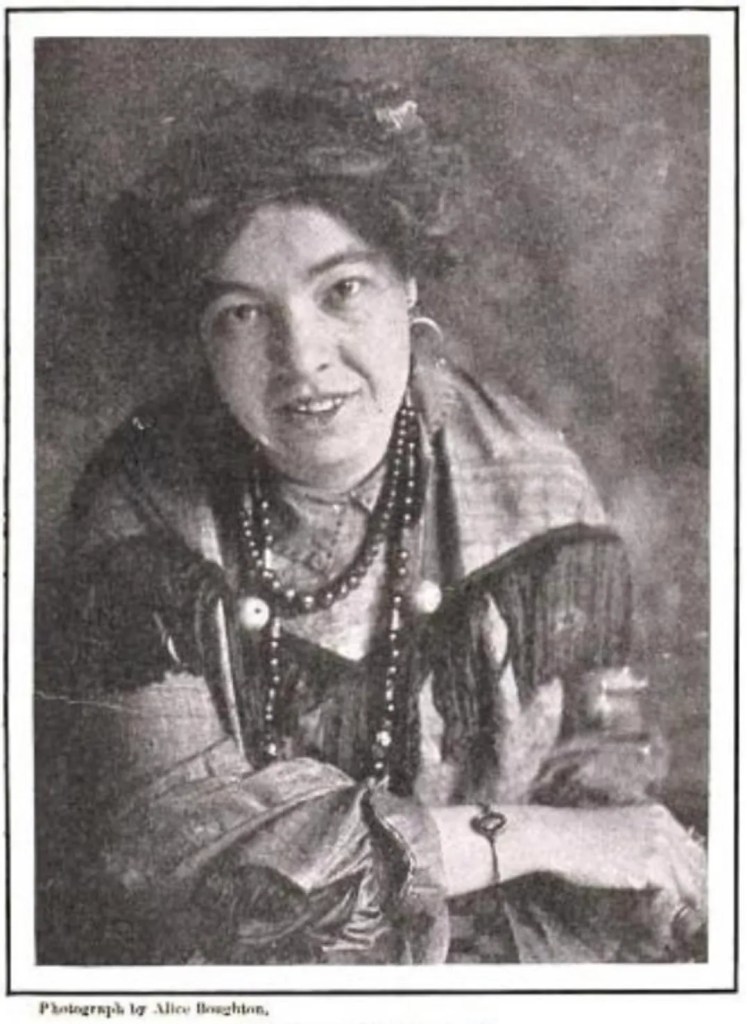
Her years in Jamaica fed directly into the persona Smith cultivated in bohemian London. She wrote and performed Jamaican folk tales in patois, dressing in colourful robes and jewellery and creating elaborately theatrical surroundings for her storytelling salons. Swallows and Amazons author Arthur Ransome described the room where she received guests as a candlelit “mad room out of a fairy tale”, crammed with paintings, fabrics, incense and assorted curios – “china toys, paperweights of odd designs… cigarette boxes and books… a wooly monkey…the cast of a woman’s head” (so…kinda like my office 😂). In this fairy-tale room, Smith, who Ransome describes as the “god-daughter of a witch and sister of a fairy”, would sit cross-legged on the floor before her audience, telling tales of Anansi. She would typically start her stories: “In a long-before time – before Queen Victoria came to reign over we” instead of the standard English “once upon a time…” Even the claret and lemonade she served to her guests was rechristened the considerably more exciting “opal hush” (apparently she told Ransome it was a favourite with the “Irish poets over in Dublin”, so there you go! When Yeats wasn’t posing about and looking bored, he enjoyed a good red wine spritzer!)

There’s def an element of cultural appropriation here to modern eyes. It’s a bit… minstrelly, in a way that I’m not entirely comfortable with. A white woman performing Jamaican patois and dressing herself in an exoticised version of Jamaican culture for largely white audiences is inevitably going to feel pretty ick from a twenty-first-century perspective. But it’s also clear from the reading I’ve done that Smith was drawing on a culture she had genuinely lived within and clearly loved, and championing Black Jamaican folklore to white British audiences at a time when it was rarely afforded that kind of attention. And, importantly for the Tarot, it also speaks to the breadth of Smith’s knowledge of folklore, mythology, and storytelling across different cultures. I think that deep well of stories and symbols is part of what gives the RWS its extraordinary archetypal richness – these images didn’t spring fully formed from Waite’s instructions alone (much as he liked to claim otherwise).

We can also see plenty of links to what we now think of as the Fool’s Journey in Smith’s art from before she had even thought about illustrating Waite’s Tarot deck. In Modernism and the Feminine Voice, Kathleen Pyne writes that “many of Smith’s landscapes with figures suggest the pitfalls along the way to enlightenment, relating psychological states in which humans struggle helplessly against emotions of jealousy, longing, and melancholy.” In other words, the idea of figures moving through symbolic landscapes and grappling with recognisable human experiences was already very much part of Smith’s artistic language. Pyne links her distinctive style to a wonderfully eclectic range of influences, including Kate Greenaway, Walter Crane, and William Blake, as well as Japanese printmakers such as Hokusai.

Smith was also a feminist and an avid supporter of women’s suffrage 🙌. She was great friends (and possibly more?) with the lesbian suffragette Edy Craig (Ellen Terry’s daughter), and the two would hang out and wear trousers and smoke cigarettes 💋👑. In 1903, she founded her own literary magazine, The Green Sheaf, before branching out into publishing with the Green Sheaf Press, producing poems and stories by women writers. She also contributed artwork to the suffrage movement. So when I occasionally get all feminist-theory-brained about the imagery in the RWS, I’m not entirely reaching, lol. These cards were illustrated by a politically engaged woman whose feminism was already finding its way into her art.

Smith was also known for creating what she called “drawings suggested by music”, allowing her pencil to follow the shapes and emotions she experienced while listening to composers such as Bach, Beethoven, Chopin, and Debussy. Debussy’s Snow is Dancing, for example, became delicate drifting lines, while Beethoven’s Appassionata inspired a strange swan-like figure with a woman’s face. According to the Illustrated London News, Debussy himself saw some of her drawings of his compositions and was “delighted” saying that they had “developed and carried his own ideas in many cases”. In a letter to the photographer and art promoter Alfred Stieglitz, who exhibited some of these music-inspired works, Smith explained that she wasn’t attempting to illustrate the music itself, but rather “just what I see when I hear music. Thoughts loosened and set free by the spell of sound… When I take a brush in hand and the music begins, it is like unlocking the door into a beautiful country.” Which also feels v. Tarot-coded to me!

Also, I’ve got to give some props to Smith for being entirely unmoved by Wagner, except to rage 😂. In the above article she explains that when she listens to Wagner she sees only “scratchy little brown fir-trees rising through a brown fog; my scalp tingles and my hair pricks; I feel so full of rage that I want to crack the heads of people together like nuts. When it is played in a room, thick curtains of brown spiders’ webs appear; sticky and evil smelling. I have come into a room after Wagner music had been played and found that sickly, sweet, evil smell clinging to everything.” Our girl does NOT have time for anti-semites!


Self-Portrait, 1907 (very Three of Wandsy!)
This led to suggestions that Smith experienced synaesthesia – where stimulation of one sense involuntarily triggers another. I get this a bit too (the number 7 is orange, for example, and the word Thursday is purple), and I can def see something of that sensory crossover in the extraordinary flow and interconnectedness of the RWS imagery. Smith seems to have had a brain that naturally translated one kind of experience into another.
Her contemporaries sometimes interpreted this in rather more mystical terms. Writing in Camera Work in 1909, Benjamin de Casseres described Smith’s drawings almost as direct transmissions from the subconscious: “These wonderful little drawings are not merely art; they are poems, ideas, life-values, and cosmic values that have long gestated within the subconscious world of their creator—a wizard’s world of intoxicating evocations—here and now accouched on their vibrating coloured beds, to mystify and awe the mind of some few beholders; to project their souls from off this little Springboard of Time into the stupendous unbegotten thing we name the Infinite.” Obvs this is somewhat purple prosey (never change Edwardian writers!), but I like the fact that years before her Tarot illustrations became the basis of an entire visual language for the subconscious, people were already responding to Smith’s art as though it opened a door into one.

However, despite this flurry of artistic success, Smith never really made it as an artist financially. Pyne notes that her correspondence with Stieglitz is “almost entirely given over to financial concerns and pleas for reimbursement for drawings sold”, rather than the lofty discussions of “art and the soul” we might imagine between them. The reality of being a working artist was (and remains, alas) rather less romantic than the dream. BABY I WANT MY MONEY! So, by 1909, Smith was brassic and increasingly disillusioned with the commercial art world. And it was at precisely this point that our pal Waite appeared with a paying gig: would she like to illustrate his proposed Tarot deck?
Writing in the Occult Review shortly after the deck appeared, Waite described Smith as “a very skilful and original artist” who also had “some knowledge of Tarot values”. He noted that she received further guidance from an unnamed teacher “deeply versed in the subject”. By the time of his 1938 autobiography, Shadows of Life and Thought, however, he was rather more dismissive. While acknowledging Smith as a talented “draughtswoman”, he claimed she never really understood the “subsurface consequence” of much of the Golden Dawn philosophy, and that he had to prevent her from “casually” introducing “floating images” of her own into their deck – perhaps a reference to her alleged synaesthesia and the visionary way she experienced and created art. Most famously (and somewhat patronisingly), he claimed that she had to be “spoon-fed carefully” when it came to some of the Major Arcana (oh do fuck off Arthur*).
BUT. Having just spent all this time looking at Smith’s artistic life before the RWS – her folklore and mythology, feminism, mysticism, symbolic landscapes, music-inspired visions and general ‘wizard’s-world’ weirdness – I find it pretty difficult to look at the finished deck and see her as simply a pair of hands dutifully illustrating Waite’s ideas. There’s an awful lot of Pixie in there too IMO, lol. It’s commonly accepted that she had a major (lol) involvement in the content and look of the Minor Arcana; so much so that the author and occultist Israel Regardie wrote that, in his opinion, Waite “had about as much insight into [the personality link to the Minor cards] as my beautiful Siamese cats. If anything, I have a sneaking suspicion that his artist, Pamela Colman Smith… was a strange clairvoyant creature whose inner vision must have had a greater effect on Waite than Waite did on her.” (I am v. much enjoying the ‘mate, my cats understand this better than you’ shade Regardie is throwing here).

Smith took just six months to complete the 78 cards (plus two additional designs), modelling several of the figures on people she knew. The Queen of Wands was based on her actress friend Ellen Terry (also featuring Smith’s black cat, Snuffles!), while Edy Craig apparently provided the model for the androgynous Magician, and Florence Farr for the World. In a letter to Stieglitz (left), Smith rather ruefully summed up the commission: “I’ve just finished a big job for very little cash!”
It’s true that Smith was paid a fairly meagre flat rate for what would become one of the most influential pieces of commercial artwork of the twentieth century, particularly when, even at the time, a single deck from Rider & Son retailed for the princely sum of five shillings – equivalent to the standard weekly rate of the newly introduced state pension.
It’s also true that her name was omitted from what became known simply as the Rider-Waite deck. BUT she did quite literally make her mark: every card bar the Fool bears her distinctive PCS monogram, resembling a caduceus, with the P forming a snake-entwined staff overlaid by the C and S.


Now, I’ve done my fair share of ranting over the years about Smith-erasure (and always call the deck the RWS rather than the RW), but, in fairness to those around her, Smith does seem to have been a textbook talented-but-head-in-the-clouds creative, without a great deal of business acumen. (Indeed, Jack Butler Yeats moans in a letter to a friend that, while a talented artist, Smith is lazy and disorganised and difficult to co-edit their journal with due to not being particularly practical!) And it is still – sadly – the case today that artists and creatives, from illustrators to session musicians, get thoroughly shafted credit-wise for work they produce on commission.
There’s also a bit of hindsight at play here. Anyone who has freelanced knows that a flat-rate commission means guaranteed money in the bank, whereas royalties mean taking a gamble on whether the thing actually sells. (I’m always reminded of Hugh Grant taking an upfront salary of £35,000 for Four Weddings and a Funeral, whereas Andie MacDowell opted for a percentage of the profits and reportedly made around $2 million!) In 1909, with Smith broke and the future success of Waite’s weird little Tarot project hardly assured, taking the cash probably didn’t seem like such a terrible deal. It only looks spectacularly shit now because those 78 drawings went on to become some of the most reproduced and recognisable Tarot images in the world.
I don’t want to suggest the RWS is all Smith either! Dawn Robinson makes the interesting point that Smith was probably already preparing to become a Catholic while she was working on the deck, suggesting that “the job was a paid commission; something she needed as a jobbing freelance illustrator, rather than due to any great [ongoing] conviction about the Golden Dawn.” It’s very easy, knowing what the RWS eventually became, to imagine its creation as some great culmination of Smith’s occult life. But for Smith herself it may have been considerably more prosaic: she was a skint freelance illustrator, increasingly drifting away from both the Golden Dawn and the boho world of literati London (she moved to Cornwall in the next decade), and Waite offered her a job. That doesn’t make the resulting artwork any less symbolically rich – but it does complicate the mythology we’ve subsequently built around its creation.
By all accounts, Smith became increasingly isolated in the years following the publication of the RWS. In 1914, she confided to a friend that she simply didn’t care for people anymore, and gave away the guest book in which she had faithfully documented the artsy and fabulous friends and visitors to her London apartment over the years – where she had scrapbooked their signatures, addresses, stories, letters, and drawings 💔. It feels like a particularly sad little bookend to the bustling bohemian world of salons, artists, actors, poets, and assorted oddballs that had surrounded the younger Pixie.
Much is made of the fact that she eventually died “penniless and obscure” in 1951 – her possessions sold to settle her debts, her grave now lost – and there is undoubtedly something desperately sad about the contrast between that ending and the extraordinary afterlife of her art.


BUT. I do also want to slightly complicate the popular image of poor forgotten Pixie dying in some miserable freezing artist’s garret. By the end of her life she was living in a flat in Bencoolen House (now a pub) in Bude which by modern standards is a really lush building. I don’t think she ever reached Austin Osman Spare levels of desperation. That’s obvs not to say Smith didn’t struggle financially. In their fab book on her life and art, Kaplan et al. recount how, while still living at the v. grand Parc Garland in 1927 (with her housekeeper and companion-til-the-end Nora Lake), she wrote to a friend: “I am really in need now. I have a house & 2 acres of ground, poultry & c – and need money badly to tide things over until I get the work going again.” Clearly, money was a recurring problem. But struggling to keep a large household afloat isn’t necessarily the same thing as living in abject poverty. And while she was certainly in debt when she died, with her remaining possessions auctioned off to pay her creditors (largely unpaid income tax bills) leaving none for poor old Nora, she had also been receiving regular remittances from a trust fund in New York. Her expenditure ultimately exceeded that income, leaving her with an insolvent estate – financial insecurity, certainly, pretty hand-to-mouthy, but not necessarily quite the Dickensian destitution implied by the oft-repeated claim that she “died in poverty”.
ANOTHER BUT. Smith’s contribution to Tarot was overlooked for a very long time, while the images she created became ubiquitous. It is crap she wasn’t able to live comfortably in her old age given the amount of revenue she’d generated for the Rider company <general side-eye at publishers, espec. academic publishers who are literally THE WORST>. So I’m v. glad that projects like Pixie’s Marseille Tarot are part of that “Pixie renaissance”, putting the artist herself – and not just the deck she illustrated – firmly back front and centre.
“Think good thoughts of beautiful things, colours, sounds, places, not mean thoughts. When you see a lot of dirty people in a crowd, do not remember only the dirt, but the great spirit that is in them all, and the power that they represent. For through ugliness beauty is sometimes found.”
– Pamela Colman Smith
.
.
.
.
Bibliography
Autostraddle (Beth) (2014). Fool’s Journey: The Fascinating Life of Pamela Colman Smith. Autostraddle. Available here.
de Casseres, B. (1909). Pamela Colman Smith. Camera Work, 27 (July 1909), 18-20.
Forbes-Sempill, E. M. L. (1927). Music made visible: An unmusical artist’s lightning impressions recorded while listening to music: The remarkable drawings of Miss Pamela Colman Smith. The Illustrated London News, 12/02/27, 258–260.
Gilbert, R. A. (1987). A.E. Waite: Magician of Many Parts. Crucible.
Kaplan, S. R., Greer, M. K., O’Connor, E. F., & Parsons, M. B. (2018). Pamela Colman Smith: The Untold Story. US Games Systems, Inc.
Katz, M., & Goodwin, T. (2015). Secrets of the Waite-Smith Tarot: The true story of the world’s most popular Tarot. Llewellyn Publications.
Pyne, K. (2008). Modernism and the Feminine Voice. University of California Press.
Ransome, A. (1907). Bohemia in London. Dodd, Mead.
Robinson, D.G. (2022). Pious Pixie: The life of Pamela Colman Smith. ArtCornwall. Available here.
Waite, A. E. (1910). The Tarot: A Wheel of Fortune. The Occult Review, XI:1. William Rider & Son Ltd. Available here.
Waite, A. E. (1938). Shadows of Life and Thought: A retrospective review in the form of memoirs. Selwyn and Blount.
Willett, C. (2022). The Queen of Wands: The Story of Pamela Colman Smith, the Artist Behind the Rider-Waite Tarot Deck. Running Press.
.
*Also, if you want some more reasons to be down on Waite, he’d previously commented “the practice of painting by women remains clumsily done… a bad imitation of nature.”
.
.
Enjoyed this post? ❤️
TarotCake is independent, ad-free, and free to read. If you enjoy my ramblings and would like to help with the costs of keeping the site running, you can support TarotCake on Ko-fi.
Share this:


You May Also Like

Is Tarot Evil? In Defence of the Cards

The Maths of Tarot: How Many Tarot Spreads Are There (Really)? And How Long Would It Take To See Them All?
